What is a Blue Zone
The term began in demographic research on places with unusually high concentrations of people reaching very old age. The best-known regions are Okinawa in Japan, a mountainous area of Sardinia, Ikaria in Greece and Nicoya in Costa Rica. Loma Linda in California joined the popular list because of its Adventist community and the research conducted there, although it is not demographically identical to the four original regions.
Extreme-longevity research begins with age validation. One birth certificate is not always enough. Researchers cross-check birth and death records, censuses, church archives, migration documents and family relationships. Public criticism has argued that some longevity claims arise from mistakes, identity switches or weak registration. A recent demographic review answered those critiques and described extensive document validation in the four central regions. The debate matters, but dismissing the entire phenomenon as fraud is not supported.
Simple, local and plant-rich food
Traditional Okinawan food relied heavily on sweet potatoes, vegetables, soy and modest amounts of animal food. Sardinian patterns included legumes, grains, vegetables, cheese and local foods. Maize, beans and squash were central in Nicoya. Ikaria followed a rural Mediterranean pattern, while Loma Linda contains several vegetarian patterns within a religious community with less smoking and a more structured lifestyle.
In Ikaria and Sardinia, the pattern resembles a traditional Mediterranean diet: abundant vegetables, legumes, herbs, olive oil, fish, simple grains, nuts and fruit. Sheep and goat cheeses and modest amounts of meat appeared as local foods rather than industrial products eaten at every meal. Animals were often raised on pasture or small farms. This resembles what many people now call organic, although the food did not necessarily carry formal certification.
Okinawa and Nicoya used different staple foods, but the principle was similar: local, seasonal, minimally processed food with a broad base of plants and legumes. The common ground is not veganism or a magic carbohydrate-to-fat ratio. It is simple food, little industrial food, less continuous eating and traditions suited to place. Adventist studies have linked several vegetarian patterns with lower mortality, but diet remains only one part of the picture.
Movement as part of daily life
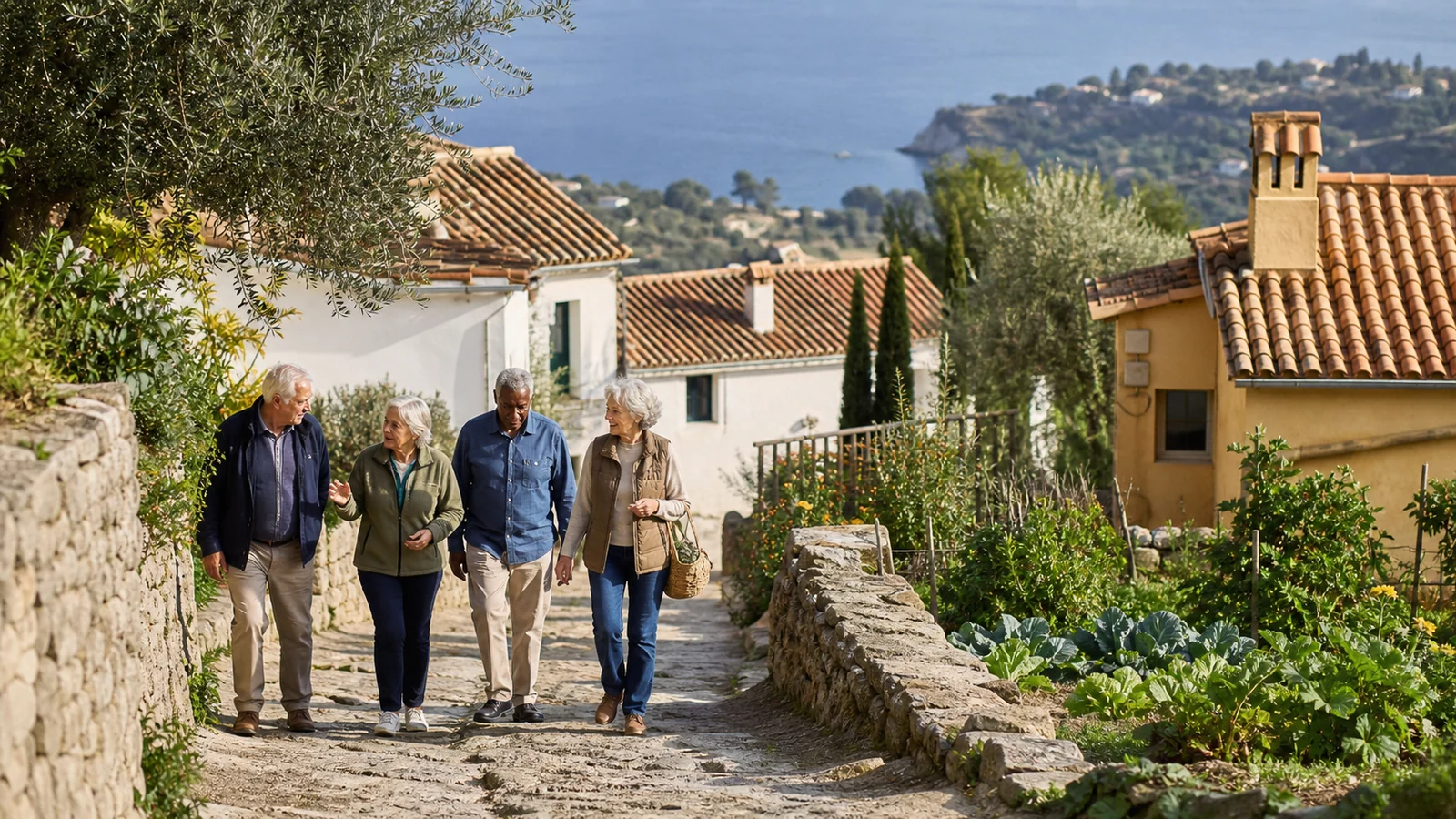
A mountain village does not need an app that tells people to stand. People walk, climb, garden, cook, carry and visit neighbours. Movement is spread through the day and continues into older age. That differs from exercising for an hour and then sitting for ten, although formal exercise can be extremely useful in modern life.
The popular story also underplays strength, muscle and balance. Rural life created natural physical loading. Someone who works at a screen and travels by car may need deliberate resistance and balance training to reproduce some of that functional protection.
Community, lower stress and a reason to get up
Older adults in these communities remained part of family and social life. They continued to play a part in daily life after retirement. Social ties can reduce loneliness, provide support during difficult periods, encourage movement and shared meals, and help someone notice a health problem in time. A sense of purpose and a useful role can shape everyday behaviour.
The rhythm of life matters as well. Regular meals, rest, conversation, prayer or another repeated ritual, physical work at a manageable pace, and time outdoors create pauses in the stress response. These communities were not free from hardship, but they included less of the modern combination of sitting, screens, rushed food and constant availability for work.
Community can support health, but it does not erase genetics, poverty, health care, infection, smoking or accidents. A Japanese word such as ikigai cannot be packaged as a Western longevity pill.
Red wine, modestly and with food
Some Mediterranean communities drank small amounts of red wine, usually with food and company rather than in large isolated doses. That is very different from heavy weekend drinking. Wine contains polyphenols, but the same families of compounds can also come from grapes, berries, olive oil, cocoa and other plants.
A non-drinker does not need to start drinking to imitate a Blue Zone. For someone who chooses to drink and has no medical restriction, the lesson is a small amount in the context of food and social life, not a large alcohol intake. Pregnancy, liver disease, certain medicines, addiction risk and other conditions can make even modest intake inappropriate.
A Blue Zone can lose its advantage
Okinawa is instructive. Older generations born before the war showed remarkable longevity patterns, while younger generations exposed to more industrial food, driving, smoking and social change did not necessarily retain the same advantage. Nicoya has also shown signs of a weakening advantage in younger cohorts.
One of the central lessons is this. Longevity is not a magical property of soil. It can fade when the living environment changes. Genes do not change within one generation, but food, movement, sleep, relationships and exposures do.
What can be brought into ordinary life
Build a better default. Keep simple food, vegetables, legumes, nuts and suitable protein at home rather than relying on willpower against industrial food every evening.
Distribute movement across the day. Walking, stairs, standing, gardening and household work add up. A sedentary life also needs strength and balance training.
Protect social connection. Shared meals, family, friendship and belonging are not decorative extras. They are part of the health infrastructure.
Do not turn tradition into dogma. There is no need to eat exactly like an Okinawan elder or a Sardinian shepherd. Use the principles that fit the body, culture, budget and medical situation.
The conclusion
Blue Zones show what can happen when simple, high-quality food, vegetables and legumes, fish and olive oil, locally raised animal foods, daily movement, social life, rest and a useful role persist for decades. The lesson is not to copy one village menu. It is to build an environment in which healthier choices feel natural, social and repeat often enough to matter.
Research and sources
- Poulain et al.: validity of Blue Zone demography and response to critiques
- Blue Zone as a demographic concept: validation, definitions and limits
- Adventist Health Study 2: vegetarian dietary patterns and mortality
- Nutrition and longevity among older Okinawans
- US National Cancer Institute: alcohol and cancer risk